



by the Brightmine Editorial Team
Drug testing can help minimize the risk of workplace accidents and injuries and improve employee productivity and attendance. However, before conducting drug testing of job applicants and employees, employers should be aware of various complex issues and compliance obligations to which they may be subject.
Federal law does not prohibit employers from testing employees and job applicants for current illegal drug use. However, testing and any subsequent action by an employer based on test results must be implemented in compliance with the federal Americans with Disabilities Act (ADA), collective bargaining agreements and other federal, state and local laws that protect workers from discrimination or privacy violations.
In addition, employers subject to federal testing requirements, such as those imposed by the federal Department of Transportation, and federal contractors covered under the Drug-Free Workplace Act of 1988, must ensure that they conduct drug testing accordingly. Further, some state and local laws may restrict the conditions under which drug testing is permitted (e.g., testing of a job applicant is only permitted after a conditional offer of employment has been extended).
A basic drug test typically screens for illegal drugs: amphetamines, cannabinoids (e.g., marijuana, hashish), cocaine, opiates (heroin, morphine, opium, codeine) and phencyclidine (PCP). This type of test is normally usually referred to as the 5-panel test for Schedule I controlled substances (under the federal Controlled Substances Act).
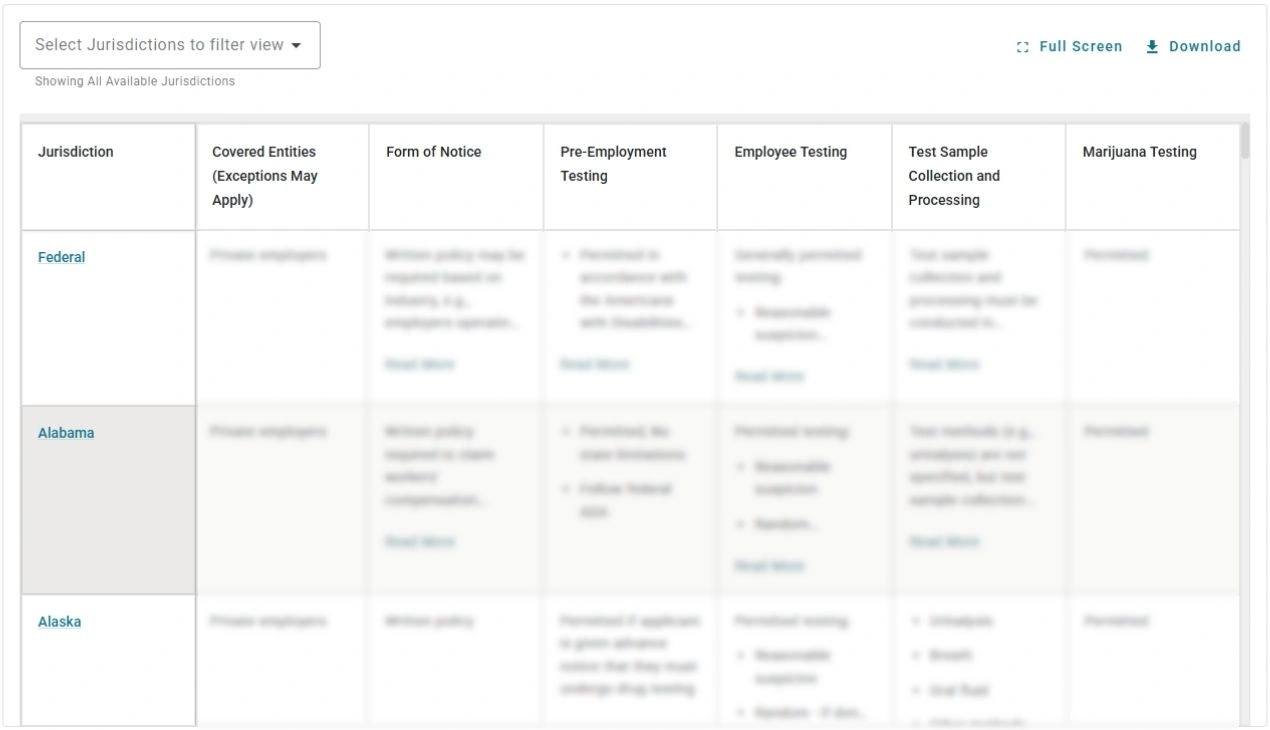
For each state and the District of Columbia, our chart indicates:
- The form of notice required to conduct drug tests (e.g., written policy);
- When preemployment drug testing is permitted;
- The types of employee drug tests that are permitted (e.g., preemployment, random, post-accident, reasonable suspicion, return-to-work, periodic, fitness-for-duty);
- Test sample collection methods (e.g., urinalysis) and processing requirements; and
- Whether testing for marijuana is permitted.
Our 50-state chart only addresses requirements pertaining to private employers. It does not address alcohol testing, local laws or industry-specific rules that may impose drug testing requirements or restrictions (e.g., federal DOT requirements) on employers.
The chart also does not address disciplinary or discriminatory protections afforded to applicants or employees who test positive for marijuana in states where medical or recreational marijuana use is legal.
Want to see more?
For full access to Drug testing requirements by state, sign up to a HR and Compliance Center subscription today.
You may also be interested in…

Salary history inquiry laws by state
Find state-by-state salary history inquiry restrictions, including rules governing compensation discussions with job applicants.
New hire paperwork and notice requirements by state
A complete state‑by‑state breakdown of required new‑hire forms and notices to support HR teams managing multi‑state workforces.
Ban-the-box laws by state and municipality
Discover how ban-the-box laws vary by state and what employers need to know before requesting criminal history in …
About the author

The Brightmine Editorial Team
Our in-house team of HR experts carefully monitors and updates the Brightmine HR & Compliance Center, the most comprehensive library of employment law and HR resources. This team has an unrivaled wealth of subject matter expertise, with an average of 15 years’ experience. They also bring invaluable, diverse career experiences to the table—the team includes seasoned employment law attorneys, former in-house counsel, SHRM certified professionals and career employment law editors.
In addition to managing the HR & Compliance Center, the Editorial Team supports the content across the Brightmine product portfolio. The Team also supports Marketing Resource Center with breaking HR news, Commentary and Insights, and expert review of key compliance resources, such as our free charts.