

Home > Products > Dynamic Pay Data

Dynamic Pay Data

Compensation decisions move fast. Your market data should too.

Make pay decisions with fresher, employer-reported market data refreshed 12 times a year—so you can benchmark with greater confidence and make better informed decisions.


Three female reward specialists discussing pay data from Brightmine
Brightmine logo

Dynamic Pay Data

Equifax logo

The workforce is changing. Benchmarking needs to catch up.

Employees challenge decisions sooner

Regulators require defensible data

Leadership requires greater confidence upfront

Built for the past

Survey-based snapshots

Annual or semi-annual data

Reflects where the market was

Locked into static views

Built for today

Employer-payroll sourced data

Refreshed benchmarks 12 times per year

Reflects where the market is now

Made for decisions in motion

What changes in the market and why stale data often fails

Dynamic Pay Data applies a 120-day compliance maturity period to all payroll data.
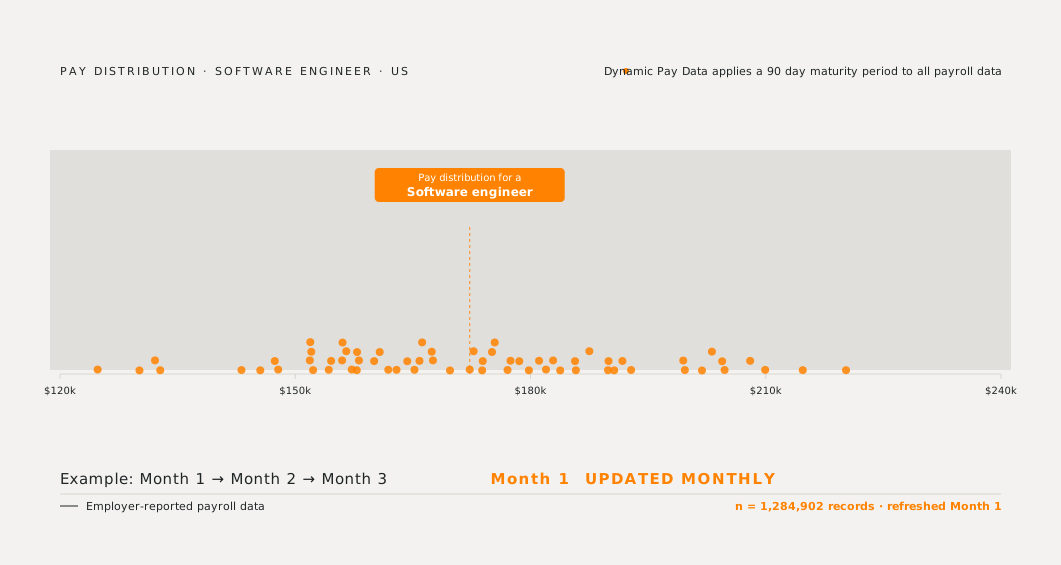
Built for better informed, real-world compensation decisions

Reliable market benchmarks

  • Benchmark pay using more recent market data
  • Built on employer payroll data—not scraped or self-reported
  • Like-for-like benchmarks by role, level, and jurisdiction

Faster, clearer comparisons

  • Compare pay using deeper, representative market data
  • Identify misalignment earlier with consistent peer benchmarking
  • Make decisions with clearer, side-by-side comparisons

Greater confidence in decisions

  • Align salary bands to current market benchmarks
  • Help ensure greater consistency across roles, teams, and locations
  • Stay better aligned as the market moves—less rework, less second‑guessing

When decisions face scrutiny, not all compensation data holds up

Different data sources serve different purposes—but Dynamic Pay Data combines greater accuracy, more scale, and freshness to support outcomes that better withstand scrutiny.

Data source

Survey data

Offer data

Job posting data

Self-reported data

Modeled or Forecast data

Brightmine Dynamic Pay Data

Accuracy

Scale

Freshness

Ease

Data source

Survey data

Offer data

Job posting data

Self-reported data

Modeled or Forecast data

Brightmine Dynamic Pay Data

Accuracy

Data source

Survey data

Offer data

Job posting data

Self-reported data

Modeled or Forecast data

Brightmine Dynamic Pay Data

Scale

Data source

Survey data

Offer data

Job posting data

Self-reported data

Modeled or Forecast data

Brightmine Dynamic Pay Data

Freshness

Data source

Survey data

Offer data

Job posting data

Self-reported data

Modeled or Forecast data

Brightmine Dynamic Pay Data

Ease

Most compensation data supports one dimension—at the expense of others. Dynamic Pay Data is designed to help you improve all four.

Most compensation data breaks down before decisions are made

Why Dynamic Pay Data better supports your decisions

Built from employer‑payroll sourced data and structured end‑to‑end to better reflect how pay actually moves—continuously and at scale.


Raw payroll inputs

Employer‑payroll sourced data across roles, levels, and locations

Aggregated, anonymized and standardized

Data is aggregated, anonymized and standardized for greater consistency

Structured for comparison

Job-classified and geo-aligned for accurate benchmarking

Ready-to-use benchmarks

Continuously refreshed benchmarks—no submissions required

Raw payroll inputs

Employer‑payroll sourced data across roles, levels, and locations

Aggregated, anonymized and standardized

Data is aggregated, anonymized and standardized for greater consistency

Structured for comparison

Job-classified and geo-aligned for accurate benchmarking

Ready-to-use benchmarks

Continuously refreshed benchmarks—no submissions required

Pay benchmarking use cases for real-world decisions

Freelance designer

Make offers that are more defensible

  • Set pay ranges that more accurately reflect market expectations
  • Reduce renegotiation and offer fallout
  • Move faster with greater confidence at the point of hire

Help resolve pay questions often without escalation

  • Address employee and stakeholder challenges with clearer market evidence
  • Reduce conflicting benchmarks across teams
  • Replace back-and-forth with better aligned outcomes

Diverse candidate
Psychotherapist

Keep pay better aligned with less rework

  • Reduce drift caused by lagging or conflicting benchmarks
  • Reduce exposure to inconsistency and regulatory risk
  • Maintain better alignment as the market shifts—less rework, less second-guessing

Frequently asked questions

Dynamic Pay Data provides access to more recent, employer‑reported payroll benchmarks to help organizations make fairer and more competitive pay decisions. In a market shaped by pay transparency, frequent job movement, and multi‑state complexity, relying on outdated surveys or inconsistent data can increase risk and slow decisions. Dynamic Pay Data helps HR and reward teams better align pay with real market conditions and explain decisions with more confidence.

Dynamic Pay Data helps teams better benchmark roles, review employee pay, and assess pay structures using more consistent market context. With regularly refreshed benchmarks, teams can reduce guesswork, spot misalignment earlier, and support clearer internal discussions around pay decisions.

Dynamic Pay Data includes:

  • Regularly refreshed benchmarks to better reflect current market conditions
  • Role‑level benchmarking using employer‑reported payroll data
  • Market comparisons to review employee pay against more consistent comparator groups
  • Support for assessing pay structures and employee placement

Yes. Dynamic Pay Data is designed for organizations managing complex pay decisions across roles, locations, and markets. It supports teams that need more consistent, better and defensible benchmarks—whether for large enterprises or scaling organizations moving beyond spreadsheets and manual analysis.

Pricing depends on your organization’s size, structure, and use cases. To discuss the right option for your team, you’ll need to speak directly with Brightmine.

Dynamic Pay Data is built from employer‑reported payroll data rather than scraped job ads or modeled estimates. The data is aggregated, anonymized, standardized, classified, and geo‑filtered to help ensure benchmarks better reflect real market conditions. Benchmarks are refreshed 12 times per year so teams are working with more current information than typically available. Dynamic Pay Data applies a 90-day compliance maturity period.

Bring your pay decisions into better focus

See how employer‑payroll sourced data delivers benchmarks that support your hiring, reviews, and ongoing change

Learn more about pay transparency

Coworking space

The evolving reality of pay transparency: Data, risk and credibility

Learn how reliable market data, structured pay practices and clear communication can support compliance, reduce risk and strengthen employee trust.

Watch now

Group of coworkers gathered outdoors near a staircase, collaborating around a laptop while seated and standing together, with plants and an industrial-style background visible.

Getting pay transparency right

Learn how to get pay transparency right with practical guidance on pay ranges, compliance requirements, and risk reduction for employers.

Download

Happy coworkers

Are your reward decisions built to earn trust?

Set pay ranges with confidence. Evaluate your approach to job architecture, range pricing, exceptions and pay transparency requirements.

Read more

See your market through a sharper lens

See how Dynamic Pay Data delivers fresher, employer-reported anonymized and aggregated payroll information to support your real-world pay decisions.

Enter your details to see it in action

    LNRS Data Services Limited and its affiliates may contact you about relevant solutions, services, events and industry insights. You can opt-out via the unsubscribe link in the communications that you receive or by contacting us.

    A member of our team will follow up to show how Dynamic Pay Data applies to your roles, locations, and pay decisions